Tag: Cooperstown

Some Thoughts on the Baseball Hall Class of 2019

The National Baseball Hall of Fame election results were announced last night and the Class of 2019 is now set. Here are my thoughts on the players who were elected, the players who weren’t, and the process in general:

    • Mariano Rivera getting elected to the Hall of Fame in his first year of eligibility was no surprise, but Rivera becoming the first player ever to get elected unanimously to the Hall was a surprise to me. A pleasant surprise. I thought for sure some crusty old baseball writer would step in and stop it from happening. [More on the crusty old  baseball writers later.] Rivera’s Hall of Fame case was an open-and-shut case and it was great to see every voter get it right.
    • Edgar Martinez getting elected in his final appearance on the writers’ ballot was no surprise either. It took ten years on the ballot for him to get voted into the Hall of Fame, but his stock had been steadily rising over the last five years and he had momentum on his side. He wouldn’t have been on my ballot, but I’ve got no beef here. He was the greatest DH of all time when he retired.
    • Seeing Roy Halladay get elected was not a shock, but I didn’t expect to see him get 85.4% of the vote. I think the writers got this one right too, though. He was one of the best pitchers in the game for more than a decade, winning two Cy Young awards seven years apart (and one in each league).
    • Mike Mussina wouldn’t have appeared one my ballot. He was consistently good/very good for two decades, but never one of the handful of best pitchers in the game. It would seem that he got elected on his longevity and durability:

      With that information, I will withhold any further objections to his induction.

    • I was disappointed to see how far short Roger Clemens and Barry Bonds fell when the final voting results were released. For the record, I would vote for Clemens and Bonds. Watching the Baseball Hall of Fame Vote Tracker over the last few weeks, I was hopeful both would see jumps similar to what Edgar Martinez saw over the last few years.

      In the end, Clemens only jumped about 2% from last year, appearing on 59.5% of the ballots this year. Bonds only jumped about 3% this year, to 59.1%. It would appear that the crusty old baseball writers who prefer not to publicly release their ballots are to blame:

      Clemens and Bonds appear to be a package deal for most voters, one way or the other, and it’s getting harder to see them getting elected in the next three years. They don’t seem to have the same “momentum” Martinez had his last few years on the ballot.

    • While steroid accusations will probably keep Clemens and Bonds out of the Hall for good, politics and personality may just postpone Curt Schilling’s induction. I say that because his polling jumped about 10% this year to 60.9%. A force in October for 15 years, Schilling deserves a spot in Cooperstown. With comparable contemporary Mussina getting in this year, I think Schilling will eventually get in.
    • I don’t think Juan Pierre is a Hall of Famer, but I thought he deserved at least a few votes. He was one of 11 players on the ballot not to receive a single vote, and one of 16 players to receive less than 5% of the vote and fall off next year’s ballot. Pierre played in 162 games for five straight years in the mid-2000s and led his league in stolen bases three times (and caught stealing seven times).
Taking a Look at the 2019 Baseball Hall of Fame Ballot

dn8qw8qh

The National Baseball Hall of Fame released the 2019 Baseball Writers’ Association of America ballot last month. While I don’t have a ballot to cast myself, I once again took a look at all of the names on the ballot to determine who I would vote for if I did have a ballot to cast. The 2019 ballot features 35 players, and voters are allowed to vote for up to 10 players.

After reviewing all 35 players on the ballot, I determined there would have been eight players on my ballot. They are:

Mariano Rivera
Barry Bonds
Roger Clemens
Sammy Sosa
Manny Ramirez
Curt Schilling
Billy Wagner
Roy Halladay

  • Mariano Rivera, the greatest relief pitcher of all time, is a no-brainer. The all-time saves leader was consistently excellent for 19 seasons. A 13-time all-star, Rivera posted a career ERA of 2.21.
  • As I’ve said before, I wouldn’t have any qualms about voting for suspected PED users. Baseball was the wild west during the Steroids Era. I don’t think we’ll ever know for sure who used, who didn’t, and who just dabbled. Rather than get into that, I’d rather just vote for the best players. That’s why I would vote for Barry Bonds and Roger Clemens.Bonds won seven MVP awards, including FOUR in a row 2001-2004. Clemens won seven Cy Young Awards and won the award back-to-back on two occasions, a decade apart. They are undeniably the best hitter and pitcher of their generation.
  • Sammy Sosa was the 1998 NL MVP and is the only man in history with three 60+ home run seasons. Sosa played in the same era as Bonds so he is not the best player of his era, but few players were ever as dominant as Sosa was for six straight seasons, 1998-2003.
  • I’ve flipped on Manny Ramirez. I wrote last year that he never won an MVP award, regularly quit on his team and teammates, and actually flunked drug tests. But, if I am being consistent and just look at the numbers, he’s a Hall of Famer. 555 home runs. 1831 runs batted in.  A career .312 hitter with a .996 OPS. The guy made 11-straight all-star teams from 1998-2008.And while it is commonly accepted that he would quit on his team at times, he was never an impediment to winning. His teams won two World Series, four pennants, and Ramirez played in 111 playoff games from 1995-2009. He was the best right-handed hitter in the game in the early 2000s and one of the biggest and best free agent signings in the history of the game. For that reason, I’m in on Manny.

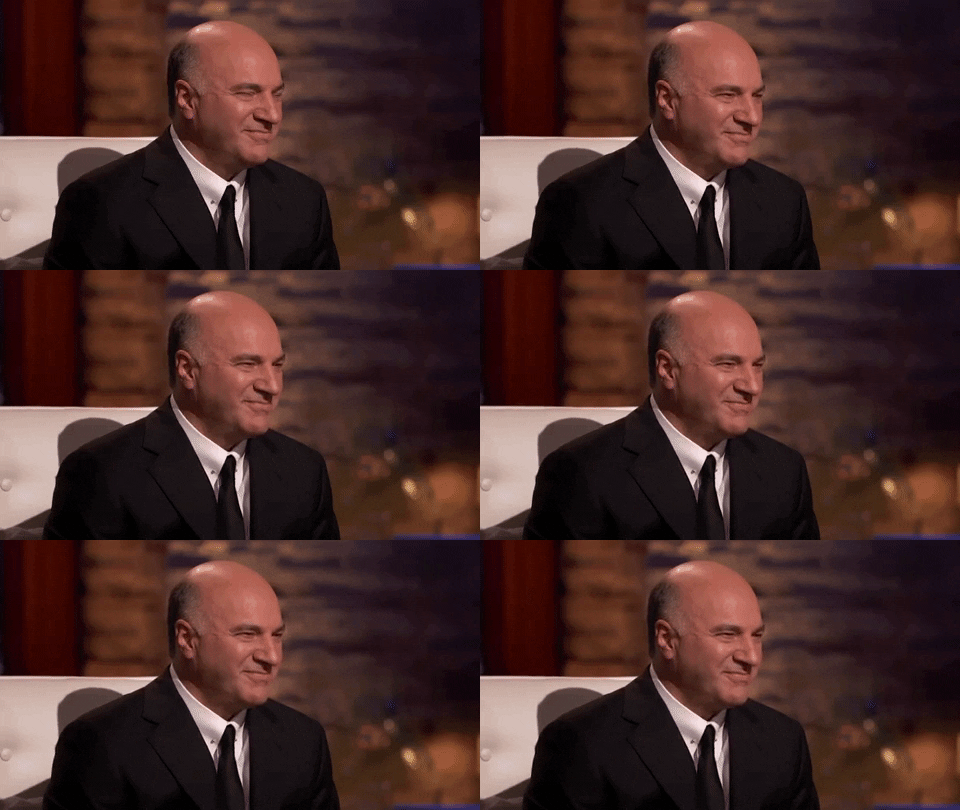
    kevin oleary GIF by Shark Tank

  • Curt Schilling was the best big-game pitcher in the game for more than a decade. He went 11-2 with a 2.23 ERA in 19 postseason appearances and won a ring in Arizona before winning two in Boston. You can’t tell the story of baseball in the 2000s without him. I wouldn’t retweet him, but I would check the box for him.
  • I’d still vote for Billy Wagner this year out of principle. Trevor Hoffman got in last year but I believe Wagner was the better reliever. The only number Hoffman has on Wagner is saves. Hoffman saved 601 games in 18 years and Wagner saved 422 in 16 years. But Wagner had a better win-loss percentage, a substantially lower ERA, he struck out more batters in almost 200 fewer innings, had a lower WHIP and a better strikeout-to-walk ratio.
  • Roy Halladay only won 203 games, but he was a beast for a solid decade. He won Cy Young Awards in 2003 and 2010, and made eight all-star teams during his 16-year career. He threw 67 complete games and 20 shutouts in a time when not many other guys regularly went the distance. On October 6, 2010, in his first postseason appearance, he threw just the second postseason no-hitter in baseball history. When the Doc was on, he was exceptional, and that’s why he’d get my vote.

Regarding some notable candidates who I wouldn’t have voted for…

Edgar Martinez was a very good player for a long period of time but was never the best player on his own team (Griffey, A-Rod, Ichiro). I do not care that he was primarily a DH. If you contribute more to your team as a DH than a first baseman or third baseman, then you should DH. But while Martinez was a professional hitter for a long period of time, he was never the most feared bat in the league (or lineup).

Mike Mussina was perennial 1A starter in the AL East for 18 years. Mussina pitched for some very good teams, but never won a ring and he was never the most feared pitcher in the game. Mussina only pitched one full season with a sub-3.00 ERA.

Andy Pettitte was a perennial #2 starter for very good teams. He logged more than a full season’s worth of playoff starts (44) and innings (276.2), and has five rings to show for it. Still, he was never one of the best pitchers in the game.


Hit me up with your thoughts on Twitter @The300sBigZ

Baines and Smith Get the Call to the Hall

Congratulations to Harold Baines and Lee Smith. They just received their game’s highest honor after long and distinguished careers. The National Baseball Hall of Fame is one of the most exclusive clubs in sports. Receiving the call to the Hall yesterday must have been an honor and a thrill. But if we’re being honest, it was probably also a bit of a surprise.

In his 22 seasons in Major League Baseball from 1980 to 2001, Baines led his league in an offensive category once. In 1984, Baines led the American League with a .541 slugging percentage. That’s it. He was a six-time all-star, and won a Silver Slugger award in 1989, but he never placed higher than ninth in MVP voting. He received MVP votes for only four seasons, 1982, 1983, 1984 and 1985. He never played in a World Series.

Baines certainly had an enviable career. He played in the big leagues for more than two decades and compiled some great numbers. He’s in the top 50 all time in hits (46th), total bases (43rd) and runs batted in (34th), though that’s due in large part to his longevity. He’s 20th in career games and 33rd in career at bats. Still a wildly successful career, but it’s hard to say that he was one of the all-time greats or even one of the best of his era.

That seems to be the opinion of the vast majority of the baseball writers, too. He appeared on the baseball writers’ ballot five times and never received more than 6.1% of the vote before falling off the ballot after 2011.

Lee Smith has a better Hall of Fame case. A seven-time all-star, Smith led his league in saves four times and retired as the all-time saves leader. He’s currently third on the all-time saves list behind Trevor Hoffman and Mariano Rivera. Good company. Smith finished in the top five in Cy Young Award voting three times in the early ’90s, and posted a career ERA of 3.03 in 1022 career games, 12th most by a pitcher.

In his 18-year career, though, Smith pitched in just four playoff games. He suited up for eight teams in 18 seasons. That’s not unusual for a relief pitched, but you wouldn’t expect an all-time great to bounce around like that.

The Hall of Fame Eras Committees, formerly the Veterans Committee, should be tasked with electing to the Hall of Fame players who may have been unfairly overlooked in their time. They should not look to push in borderline candidates like Baines, Smith and Jack Morris and Alan Trammell last year, players who already had their fair shot on the writers’ ballot.

The election process isn’t perfect, but it does seem to get it right more often than not. More inductees like this from the Eras Committees will water down the baseball Hall of Fame and turn it into the basketball Hall of Fame. And if that happens, you better believe I’ll be pushing hard for Johnny Damon the next time the Today’s Game Committee meets.


Close But No Cigar For El Tiante

Lost in between the news of Giancarlo Stanton’s trade to New York and the Patriots tough defeat in Miami over the last few days was the fact that Luis Tiant was up for election to the Baseball Hall of Fame again. Unfortunately for Tiant and his fans, his Hall of Fame candidacy came up short once again. Looking at his numbers, though, that’s the right call.

Tiant played for 19 seasons, but only received Cy Young Award votes on three occasions and never took the award home. He didn’t receive any Cy Young Award votes after arguably his best season, 1968, but that had more to do Denny McLain going 31-6 and pitching 28 complete games. Tough luck for Tiant I suppose, but he had some pretty lean years too. He went 9-20 a year later in 1969 and got off to a rocky start in Boston in 1971.

Looking at all of his seasons on Baseball-Reference.com, Tiant had some great years and some not so great years but was generally a pretty good pitcher for 17 years. He was a big part of a very fun time in Red Sox history and is rightfully a member of the Red Sox Hall of Fame. Unfortunately, that doesn’t get you into Cooperstown. You can be brilliant over a shorter career – Sandy Koufax, Pedro – or you can compile stats over a longer career – Nolan Ryan, Tom Glavine – but Tiant gets caught in between in no man’s land.

The fact that baseball fans and writers have been debating Tiant’s Hall of Fame resume for literally 30 years is a great example of how broken the voting system is.  At least it appears to have gotten this one right.

Check back later this month for my mock Hall of Fame ballot.  You can see who I would’ve voted for last year here.